A room you walk through.
Alice makes ceramics that move. Motors turn, magnets twitch, water drips through funnels onto the floor over the run of a show, wax builds up until the candles rock. Her site showed all of it as still photographs. This is the rebuild: her films where films exist, a reconstruction of every sculpture labelled as a reconstruction, and her own writing at a measure you can read.
The index, top to tail. Her photograph of the installation, the works one screen at a time, the walk going sideways, her statement, and a way to reach her.
Her work moves. Her website did not.
Every piece Alice makes is time-based. Hour Watching is a water clock: across the run of the exhibition, water drips through the funnels, down the channels and onto the floor. Frog Offering accumulates wax until the candles rock. Talking with Ceramic Tongues has a motor, a sensor and a magnetic clay body she developed herself, and it moves when you get close to it.
A photograph cannot carry a work whose subject is duration. That is a mismatch of medium, not a matter of taste, and it was the whole brief before anyone wrote one.
Underneath that sat a smaller problem and a worse one. There was no way to reach her. No address, no form, and a nav item reading About / CV on a page that had neither. For an artist three years out of an MFA with three solo shows behind her, that is the most expensive thing missing from a website.
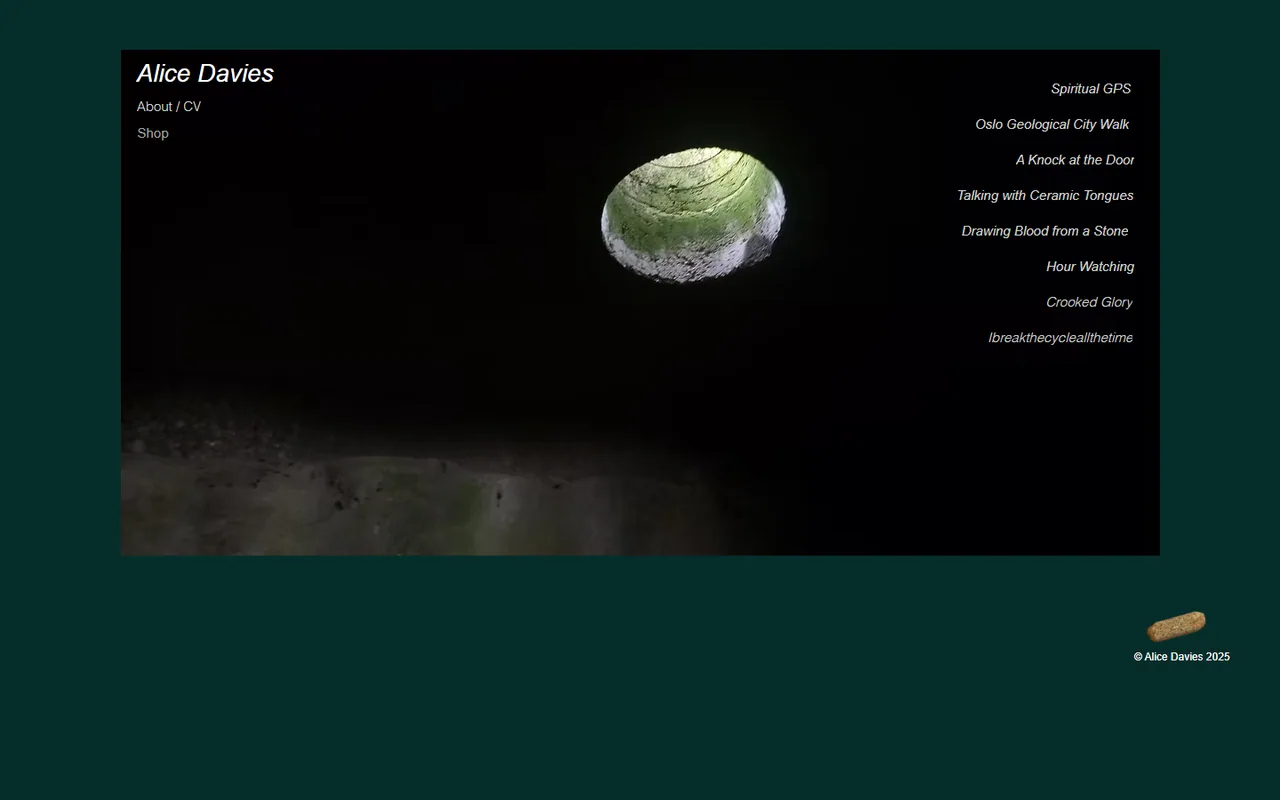
Before · alicedavies.co.uk, captured at 1440×900
153 characters a line, down to 65.
Her writing is the strongest asset she has. She cites Kircher and Della Porta by name, names every mineral and firing temperature, and puts Neolithic sites and late-Renaissance natural philosophy in the same paragraph. It is research-led, materially precise, and nothing like the way most artists write about their own work.
It was set at 153 characters a line: 15px type in a column fixed at 1,198px, which does not move when the browser does. Both frames below are the same page at the same 1440×900 viewport, and the words are identical.
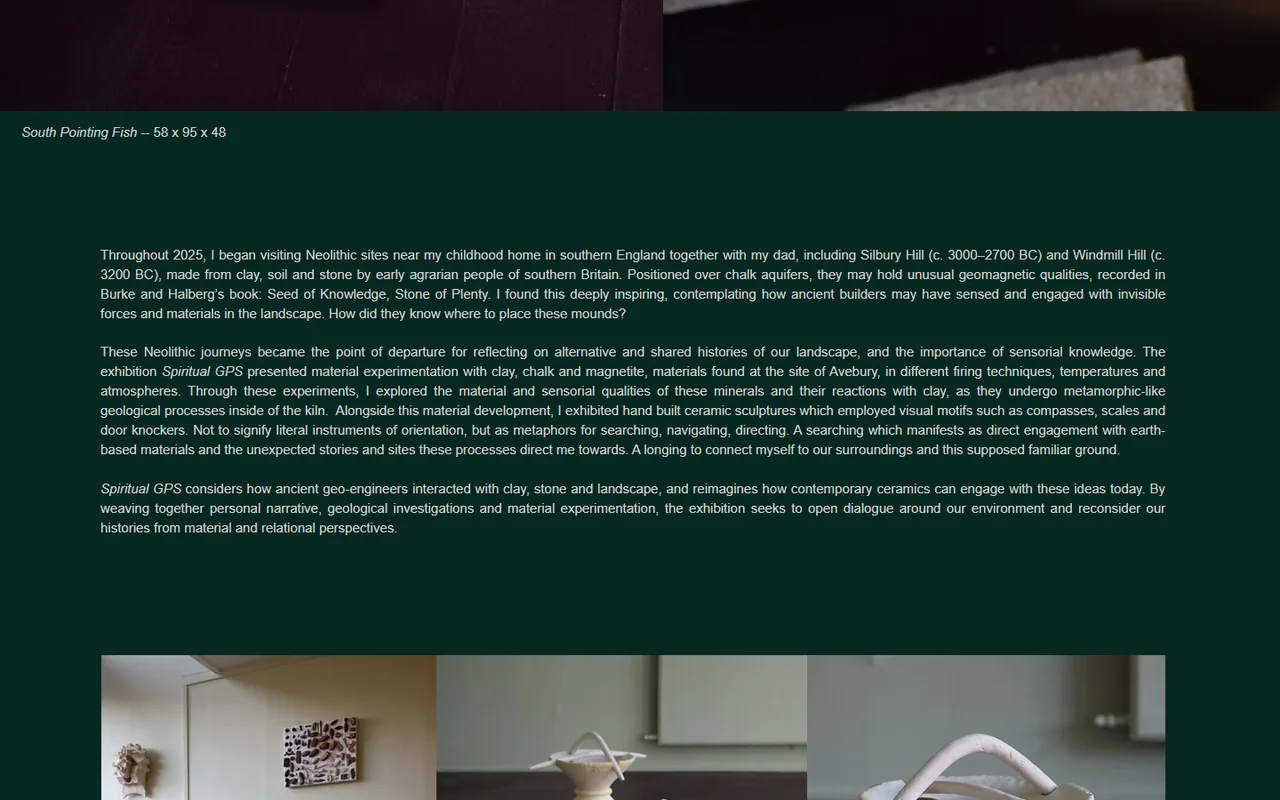
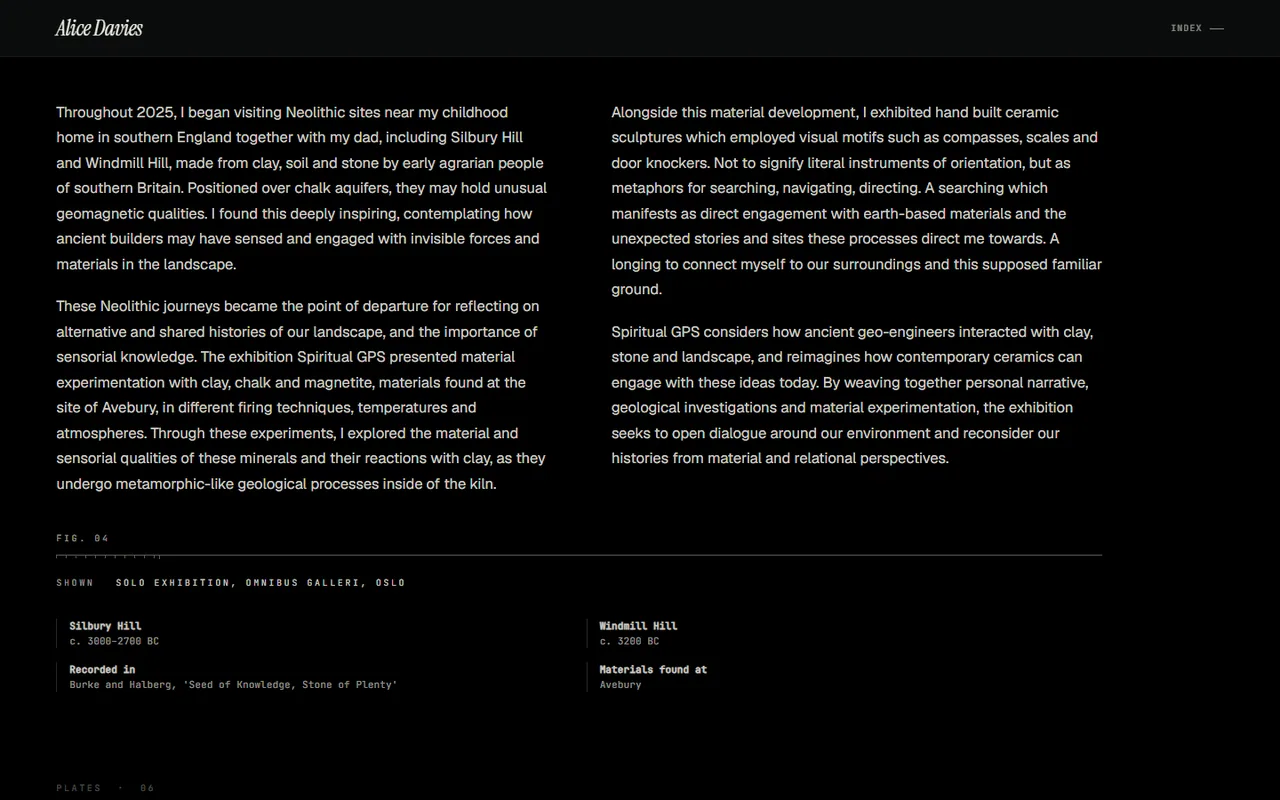
The number got smaller and got true
My own notes said 191 characters a line, and it had been repeated into three documents before anyone checked it. Measured off rendered lines at 1280, 1440, 1600 and 1920, it is 153 on this page, 155 on another and 124 on a third. 191 is not reproducible at any width; it looks like column width divided by an average glyph, rather than a count.
The corrected figure is a smaller claim and a better one, because it is one anybody can check in a browser in thirty seconds.
Pure black, because a seam would show.
The ground is #000000 and not a near-black, and that is structural rather than a preference. A WebGL canvas clears to black. Her photographs sit on black. Anything else and the two blacks differ by a few points, so a seam runs across every join between them.
The first version used #0b0e0d, which carries a faint green. A feathered plate dissolved into something very slightly different from the room it was dissolving into, and the canvas put a visible edge across the page. On true black there is nothing to give the join away, which is what lets a rendered object and a photograph share a scroll.
Nothing else sets a background of its own. No bands, no rules between works, no footer colour. Give any section a ground and the room stops at that section.
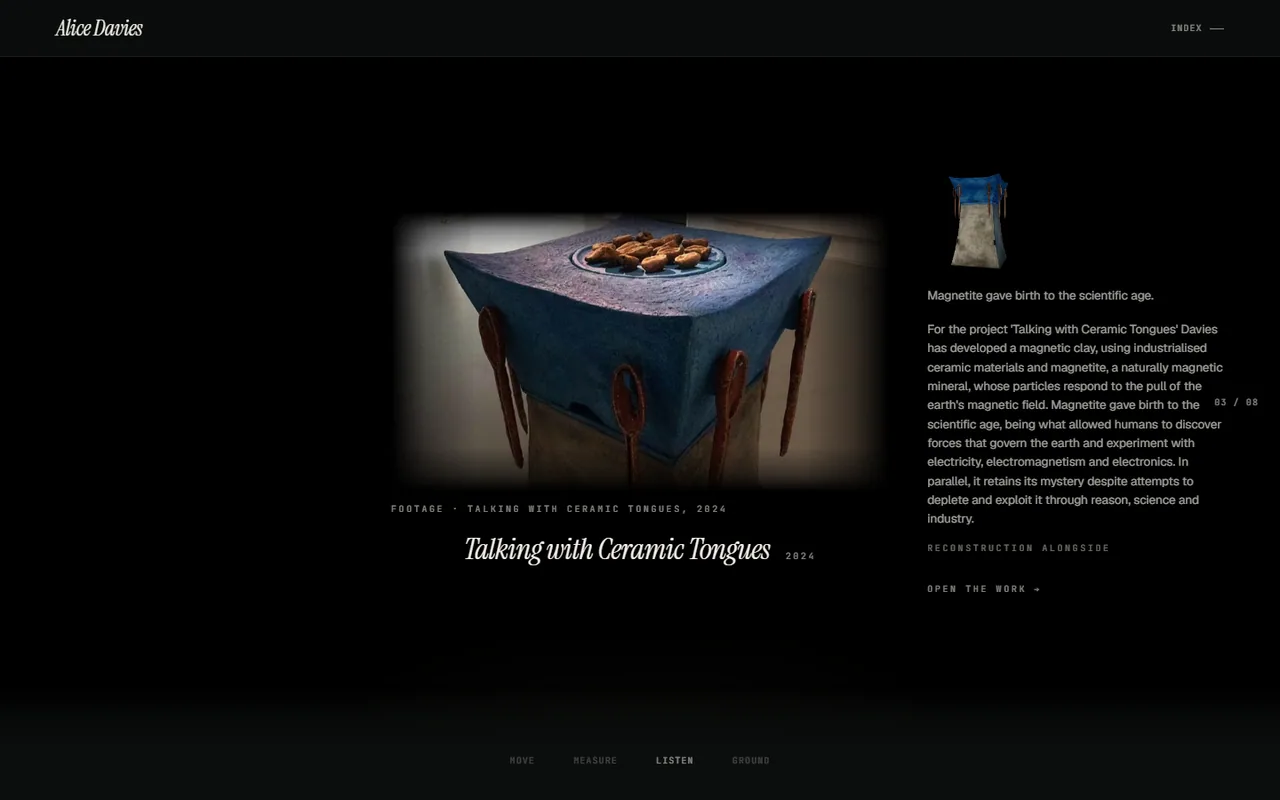
No mask on her pixels. The darkness does the blending.
Rebuilt from one photograph, and labelled as such.
Seven of her sculptures are in the browser as 3D reconstructions, each built from a single photograph. They turn slowly in the dark beside her own picture of the work, at the size of a specimen, and they open at full scale on that work's own page.
Every one carries a one-word mark, and the rule holds across the whole site: Footage is real documentation of the work moving, Camera is a camera move or a reconstruction over something that does not. A visitor never has to guess which they are looking at.
That mark is why the reconstructions are allowed to exist at all. Her artwork is never generated. The presentation around it can be, and the site says which is which on the same screen rather than in a footnote.
Six of the seven were built from one image each, so their backs are invented. The fog is what lets them be present without being examined.
Four projects, four different doors.
Seven pages opening on the same object centred on black read as a slideshow rather than as seven projects. Each one now opens on what that work actually was, and which door a project gets is a line in its own markdown file rather than a branch in a component.
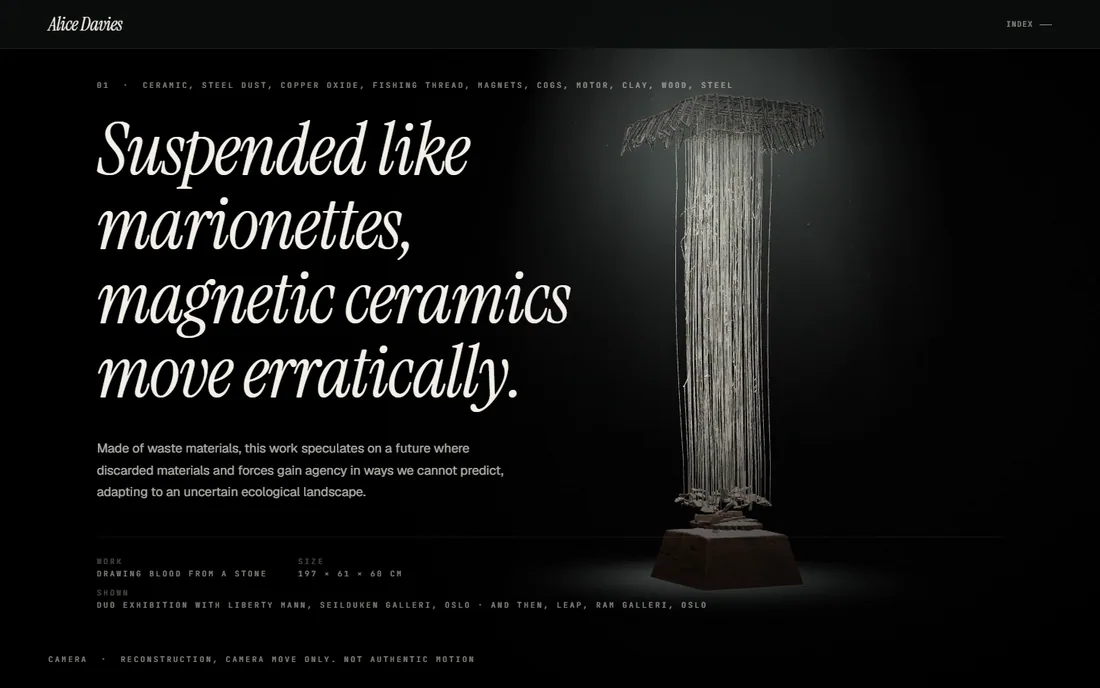
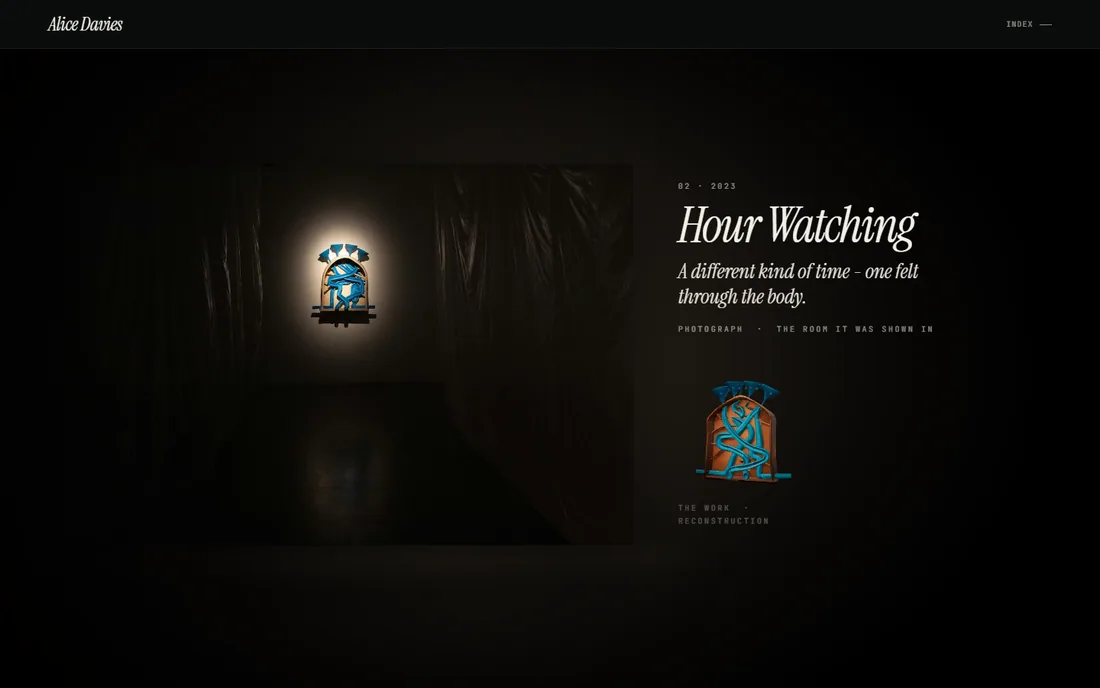
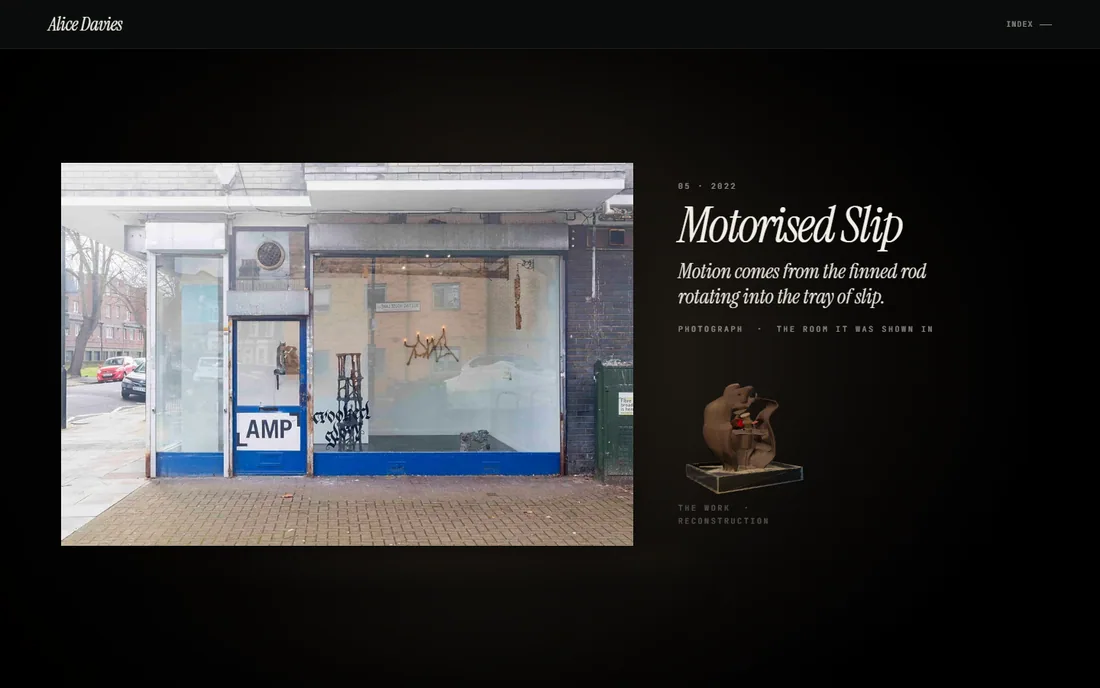
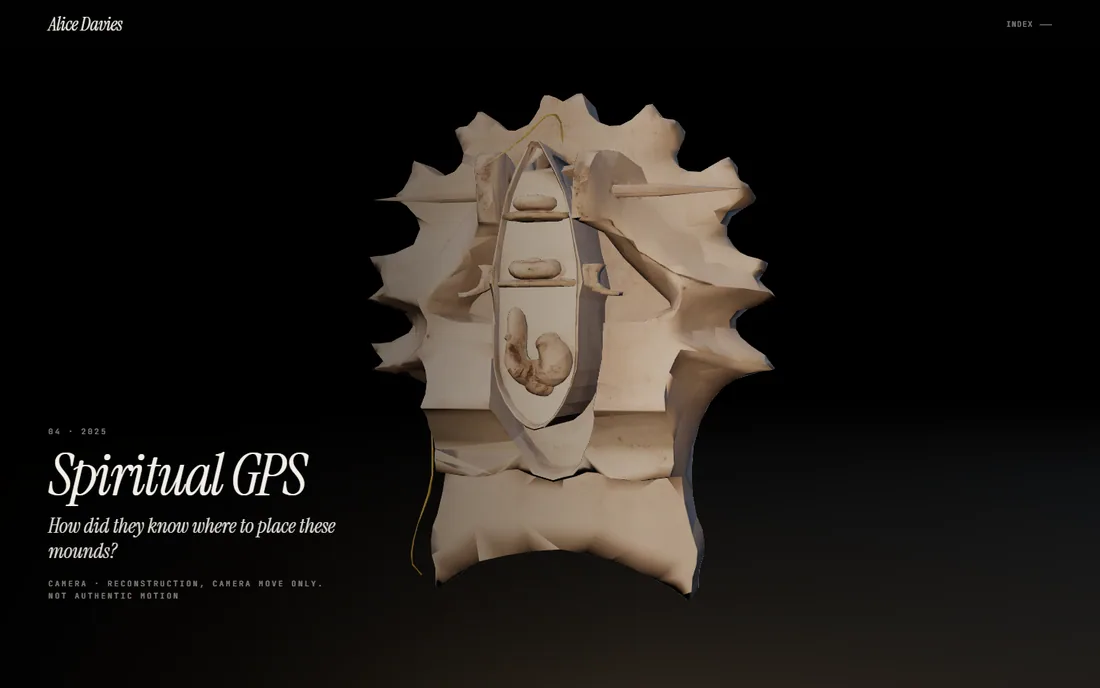
Two renders matching is not evidence
The first door was wrong twice. Asked to match a concept, I rendered the page and the concept side by side, found byte-identical code, and concluded the difference was chrome. It was not: the two pointed at different models. The plinth is a wide low slab that fills the frame edge to edge once normalised to hero height; the work is a tall thing.
Identical code means two paths agree, not that the right asset is loaded. Opening the poster frame would have settled it in four seconds.
Sideways, because the walk was.
The walk moved an audience sideways through a city, reading its building stones, so it is the one screen on the site that scrolls sideways. A tall block supplies the travel, a sticky stage pins, and a row of full-screen bays is translated on X by scroll position. Her three documentary photographs alternate with her three paragraphs.
The mechanism is borrowed from Matt Smithwood's selected-work section. The look is not, and that distinction is the whole rule: a structural idea carries between sites, a signature does not.
One deliberate departure. His bays run full height with type laid over them. Hers cannot, because these are daylight street photographs and the brightest images on the site by a distance, and chalk type over them failed on sight. So the stage is banded: ground at head and foot, bays filling the middle, every word on black. Reduced motion gets no pinning and no sideways travel at all.
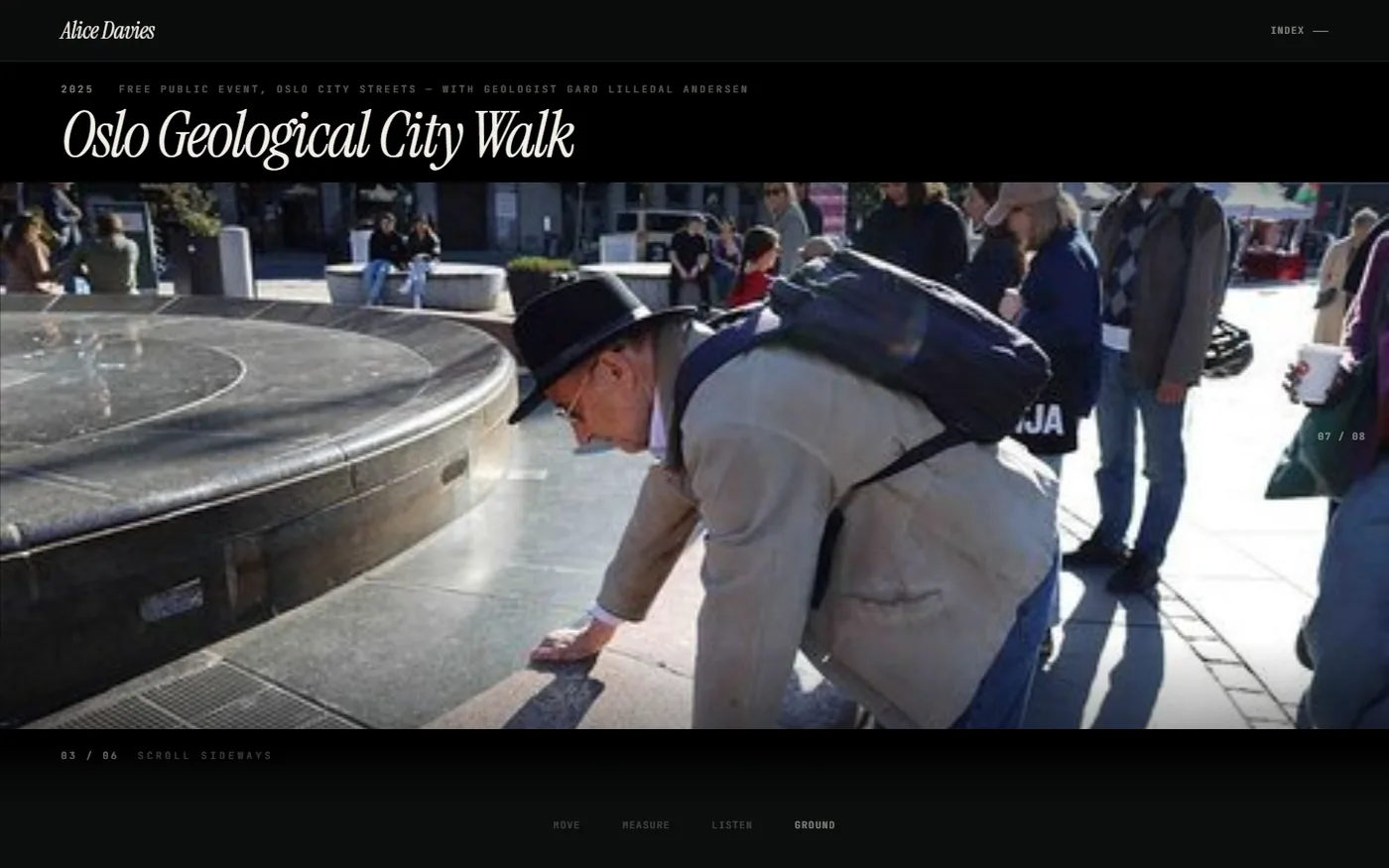
Photo: hers. One bay of six, at rest.
Her words, and a way to reach her.
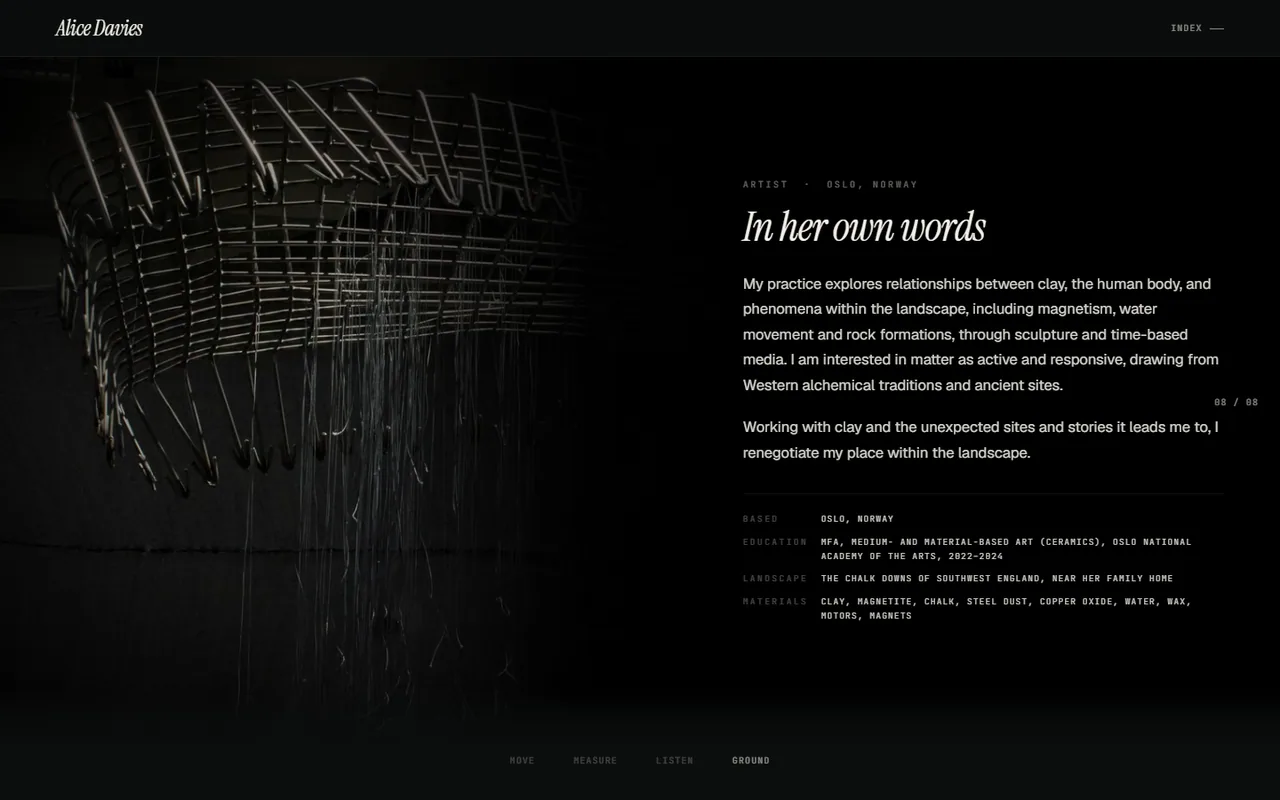
The entrance used to be a screen about one work: its lead, its dimensions, the venue it was shown in. Someone arriving from a curator's email, or from a search for her name, got no answer to the only question they came with. It opens on her now, and a section further down carries the artist statement in full, verbatim. Every biographical fact on it is sourced from her own About page or the academy's graduation listing, and the two we do not have, a full CV and a resolved date for one work, are absent rather than guessed at.
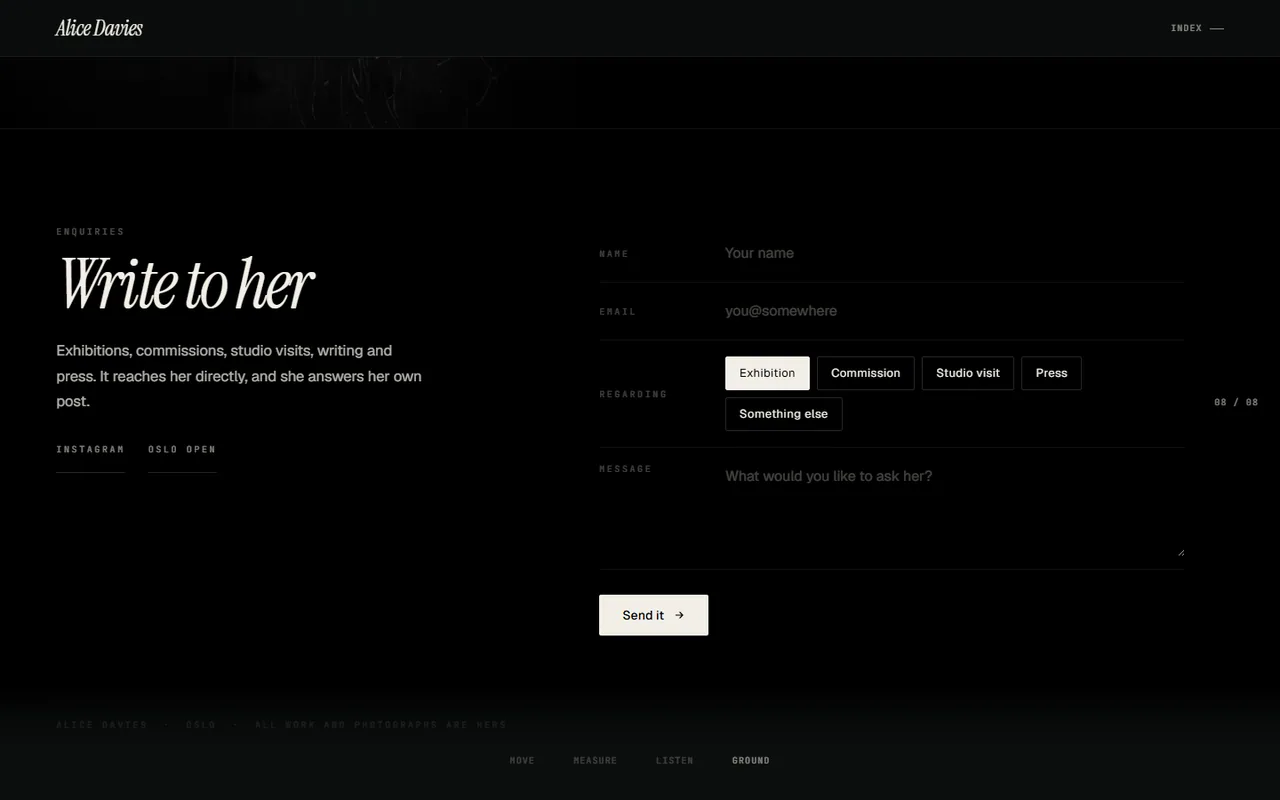
The site also has a primary action for the first time. The enquiry form is set the way every specification on the site is set, a wide-tracked term, a hairline, a value, so filling it in is writing your own label and hanging it next to hers. Behind it sits a two-tier spam defence ported from four other sites: it drops only on things a person cannot do, and anything judged by content is tagged rather than deleted.
Where it stands
The site is complete on a preview URL and not yet on the domain. Two things stand between it and launch: the enquiry endpoint needs its two mail secrets set, and DNS needs to move. Neither is a finishing touch, and until the form actually delivers there is no result to report, so this page does not claim one.