00 / Application · Research Fellowship in Design · Royal Commission for the Exhibition of 1851 · 2026Application · 2026 round · outcome due November
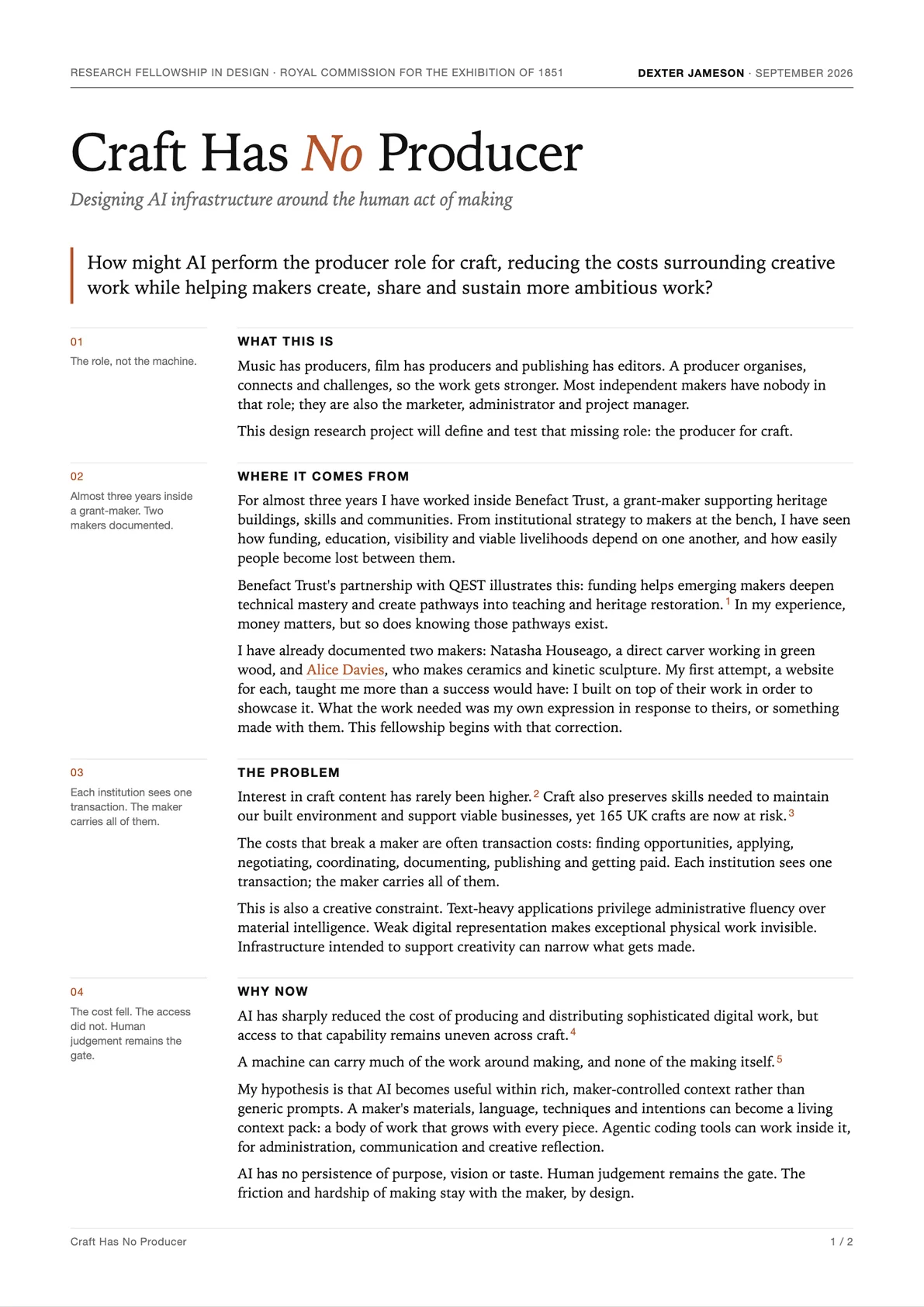
Craft has no producer.
Designing AI infrastructure around the human act of making
This is the longer version of my two-page application: the same argument, with the references, the numbers and the ideas that did not fit.
The research question
How might AI perform the producer role for craft, reducing the costs surrounding creative work while helping makers create, share and sustain more ambitious work?
Music has producers. Most independent makers have nobody in that role.
Music has producers, film has producers and publishing has editors. A producer organises, connects and challenges, so the work gets stronger. Most independent makers have nobody in that role; they are also the marketer, administrator and project manager.
This design research project will define and test that missing role: the producer for craft.
MusicProducer
FilmProducer
PublishingEditor
CraftNobody in the role.The maker, who is also marketer, administrator and project manager
The producer role in four fields · in craft, nobody holds it
A wicked problem. It deserves a service design lens: focus on the interaction of stakeholders to harness technology for real impact.
From my outline, 10 September 2026
02 / Where it comes from
What working inside a funder showed me, and the mistake I made first.
I have spent almost three years inside a grant-maker.
For almost three years I have worked inside Benefact Trust, a grant-maker supporting heritage buildings, skills and communities. From institutional strategy to makers at the bench, I have seen how funding, education, visibility and viable livelihoods depend on one another, and how easily people become lost between them.
Benefact Trust’s partnership with QEST illustrates this: funding helps emerging makers deepen technical mastery and create pathways into teaching and heritage restoration.1 In my experience, money matters, but so does knowing those pathways exist.
I have already documented two makers: Natasha Houseago, a direct carver working in green wood, and Alice Davies, who makes ceramics and kinetic sculpture. My first attempt, a website for each, taught me more than a success would have: I built on top of their work in order to showcase it. What the work needed was my own expression in response to theirs, or something made with them. This fellowship begins with that correction.
Natasha Houseago · the walk. Each carving is rebuilt in 3D from her own photographs and turns as you scroll. The case studyAlice Davies · the rooms. Ceramic and kinetic works as 3D objects, each lit alone in a dark museum room. The case study
Their workMine
1
On top of their work
What I did first: a website for each, built to showcase.
2
In response to it
My own expression, answering theirs.
3
Made with them
The collaboration this fellowship starts from.
The correction · from building on top of their work to making with them
I know craft organisations from the board to the bench, and I know how their money moves.
From my drafts, September 2026
Awareness and educational pathways remain a critical issue.
From my outline, 10 September 2026
03 / The problem
Seven costs that land on one person.
Each institution sees one transaction. The maker carries all of them.
Interest in craft content has rarely been higher.2,3 Craft also preserves skills needed to maintain our built environment and support viable businesses, yet 165 UK crafts are now at risk.4
The costs that break a maker are often transaction costs: finding opportunities, applying, negotiating, coordinating, documenting, publishing and getting paid. Each institution sees one transaction; the maker carries all of them.
This is also a creative constraint. Text-heavy applications privilege administrative fluency over material intelligence. Weak digital representation makes exceptional physical work invisible. Infrastructure intended to support creativity can narrow what gets made.
Seven transactions, each with a separate institution
Finding opportunities
Applying
Negotiating
Coordinating
Documenting
Publishing
Getting paid
The makercarries all seven
The costs around making · seven transactions, one maker
Audience figures, self-reportedChange in UK employment, 2011 to 2020, per cent · right of zero is growth · before generative AI · Design Council5
The same list records no UK craft extinct since 2023, and gives some crafts resurgent status for the first time.4
UK crafts at risk on the 2025 Red List · one square per craft · clay marks the 12 added to critically endangered in 2025 · Heritage Crafts4
The critical issue is sharing work in a digital world.
From my outline, 10 September 2026
04 / Why now
Cheaper tools, read against the evidence on judgement.
A machine can carry much of the work around making.
AI has sharply reduced the cost of producing and distributing sophisticated digital work, but access to that capability remains uneven across craft.6
In the study’s evaluations, several AI systems matched or beat the commissioned images.
US dollars per image, log scale · lower is cheaper · generation cost only: briefing, selection, rights and revision are not priced · Hartmann, Exner and Domdey6US dollars per million tokens, querying a language model at a fixed capability level · lower is cheaper · Stanford HAI7
A machine can carry much of the work around making, and none of the making itself.8
Exposure to generative AI · rank of 427 occupations, computed from the released scores · 1 = most exposed · task overlap, not job loss; craft scores are low, not zero · Gmyrek, Berg, Kamiński et al.8
My hypothesis is that AI becomes useful within rich, maker-controlled context rather than generic prompts. A maker’s materials, language, techniques and intentions can become a living context pack: a body of work that grows with every piece. Agentic coding tools can work inside it, for administration, communication and creative reflection.
Living context pack
The maker’s body of work
materials
language
techniques
intentions
Agentic coding tools work inside it
for administration, communication and creative reflection
It grows with every piece.
Outputs pass through
One gate:the maker’s judgement
before anything is
Published
The living context pack · one gate before anything is published: the maker’s judgement
Using AI to weave connections at scale, combine and iterate ideas and creative outputs. The search tree of problem solving can be captured and shared.
From my outline, 10 September 2026
AI has no persistence of purpose, vision or taste. Human judgement remains the gate. The friction and hardship of making stay with the maker, by design.
What the evidence says, both ways
Studies of AI at work find gains and losses, and which one you get depends on the task and on the person using it.
Correct answers, per cent · higher is better · a task outside the frontier of what AI does well, from a study of 758 consultants · inside it, consultants using AI finished 12.2% more tasks, 25.1% faster · Dell’Acqua et al.9
In an experiment with 453 professionals, AI assistance cut the time taken by 40% and raised quality by 18%, and 68% of those given it submitted its first output unedited.10
Among 5,172 support agents, an AI assistant raised resolutions per hour by 15.2% on average: the least skilled gained about 36%, the most skilled almost nothing.11
Among 640 Kenyan small-business owners, AI advice had an average effect indistinguishable from zero: low performers did nearly 10% worse, and high performers may have gained over 15%.12
The brief asks for mess and frailty.
Mess and frailty
The Commission’s brief says it seeks to embrace the messiness of the human brain and the frailty of the human character.13
We wish to be seen, to be immortalised. The messiness comes from the interactions between humans. Only humans can feel intuitively what has not been said. We live in the world with a shared context of feeling, events and unease, the same existential dread, the same human condition. Guilt, shame. Our shadow and archetypes. Things you can only share with the people of your time, in the same time and space.
From my notes, August 2026
05 / What I will do
Each demonstrator pairs practical support with a piece made together.
Three demonstrators, made with makers.
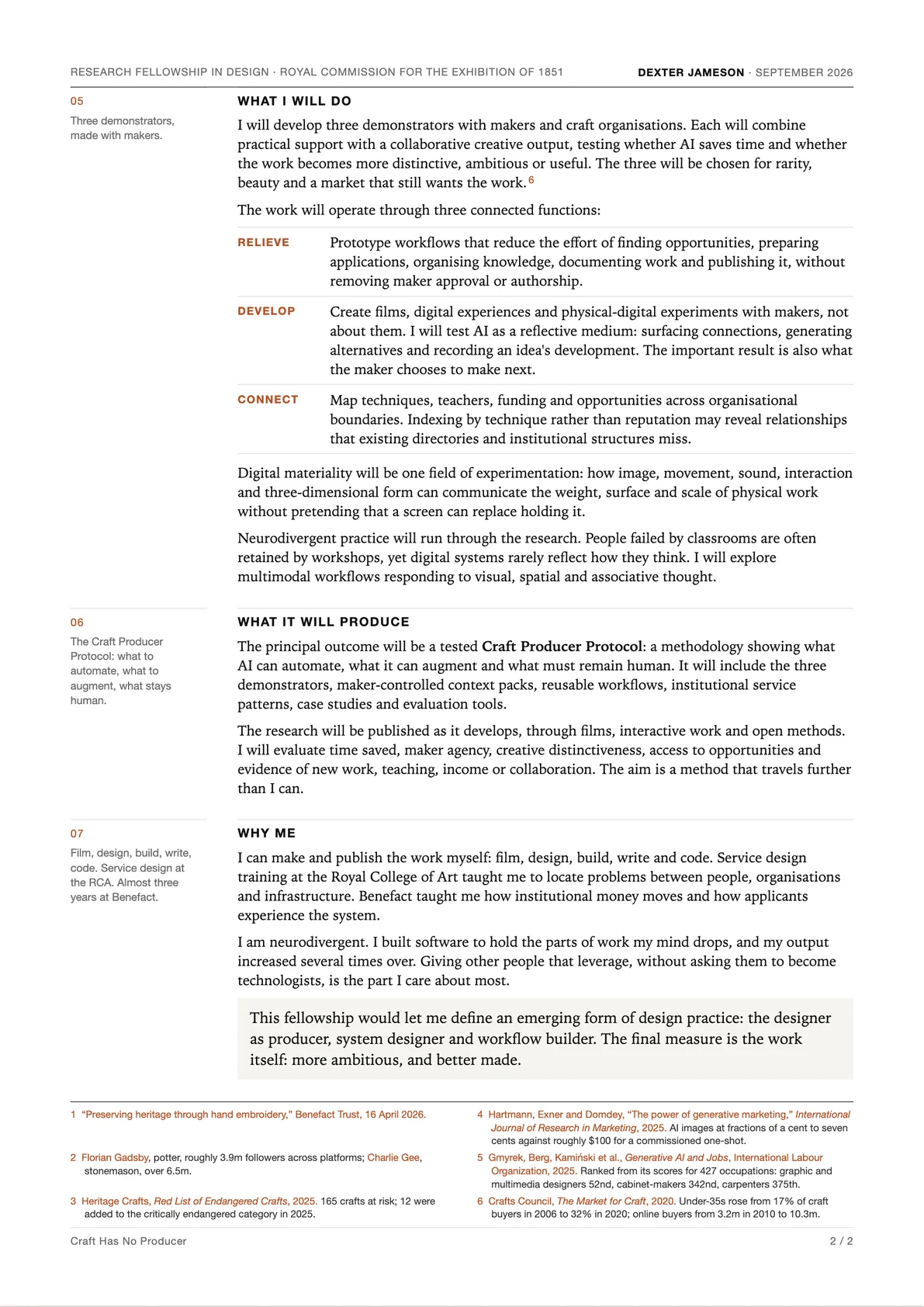
I will develop three demonstrators with makers and craft organisations. Each will combine practical support with a collaborative creative output, testing whether AI saves time and whether the work becomes more distinctive, ambitious or useful. The three will be chosen for rarity, beauty and a market that still wants the work.14
The work will operate through three connected functions:
Relieve. Prototype workflows that reduce the effort of finding opportunities, preparing applications, organising knowledge, documenting work and publishing it, without removing maker approval or authorship.
Develop. Create films, digital experiences and physical-digital experiments with makers, not about them. I will test AI as a reflective medium: surfacing connections, generating alternatives and recording an idea’s development. The important result is also what the maker chooses to make next.
Connect. Map techniques, teachers, funding and opportunities across organisational boundaries. Indexing by technique rather than reputation may reveal relationships that existing directories and institutional structures miss.
Digital materiality will be one field of experimentation: how image, movement, sound, interaction and three-dimensional form can communicate the weight, surface and scale of physical work without pretending that a screen can replace holding it.
Neurodivergent practice will run through the research. People failed by classrooms are often retained by workshops, yet digital systems rarely reflect how they think. I will explore multimodal workflows responding to visual, spatial and associative thought.
Living context pack
materials
language
techniques
intentions
The maker’s body of work, growing with every piece
Relieve
Prototype workflows that reduce the effort of finding opportunities and publishing work, without removing maker approval or authorship.
Develop
Create films, digital experiences and physical-digital experiments with makers, not about them.
Connect
Map techniques, teachers, funding and opportunities across organisational boundaries.
Relieve, Develop, Connect · three functions drawing on one context pack
The market that still wants the work
Share of craft buyers under 35 (%), people buying craft online, craft sales (£) · 2006 to 2020 · higher is a larger market · each panel on its own scale · Crafts Council14
Treat an endangered craft as an economic opportunity, not a conservation case.
From my drafts, September 2026
In my own notes
Before Relieve, Develop and Connect had names, my outline listed what I would do.
Actively produce creative output at scale to support the promotion of crafts.
Provide the context needed for craftspeople to use AI themselves.
Bring crafts to life in the digital medium, supporting their work by layering creative expression in new ways, skeuomorphism: materials, texture, sound, 3D objects, digital experiences that mimic real-world physical objects and textures.
Explore the combination of the new medium and the old traditions.
Bring this together to map, index and connect disparate crafts.
Capture the key learning and process in a new design methodology, built for the new role of designer emerging as producer.
The sixth item is among the ideas not included.
From my outline, 10 September 2026, lightly shortened
06 / What it will produce
The protocol is the output; where its lines fall is still a hypothesis.
What to automate, what to augment, what stays human.
The principal outcome will be a tested Craft Producer Protocol: a methodology showing what AI can automate, what it can augment and what must remain human. It will include the three demonstrators, maker-controlled context packs, reusable workflows, institutional service patterns, case studies and evaluation tools.
The research will be published as it develops, through films, interactive work and open methods. I will evaluate time saved, maker agency, creative distinctiveness, access to opportunities and evidence of new work, teaching, income or collaboration. The aim is a method that travels further than I can.
Working hypothesis. The fellowship tests where each line actually falls.
Automate
Finding opportunities
First drafts of applications
Formatting
Scheduling and coordination
Augment
Documenting
Editing film
Writing
Publishing
Mapping connections
Generating alternatives
Human
The making
The maker’s approval
Authorship
Taste
What to make next
The Craft Producer Protocol as a working hypothesis · the dashed lines are what the fellowship tests
What I will evaluate
Time saved
Maker agency
Creative distinctiveness
Access to opportunities
Evidence of new work, teaching, income or collaboration
Leverage my network to co-develop strategies for new funding opportunities which support the creation of a new generation of craftspeople.
From my outline, 10 September 2026
07 / Why me
What I can make without outsourcing it.
I can make the work myself.
I can make and publish the work myself: film, design, build, write and code. Service design training at the Royal College of Art taught me to locate problems between people, organisations and infrastructure. Benefact taught me how institutional money moves and how applicants experience the system.
I am neurodivergent. I built software to hold the parts of work my mind drops, and my output increased several times over. Giving other people that leverage, without asking them to become technologists, is the part I care about most.
I’m an extreme optimist about the use cases of AI for everyone: I want to bring it to the least technical.
From my notes, August 2026
I want to bring to life human craft and personality.
From my notes, August 2026
This fellowship would let me define an emerging form of design practice: the designer as producer, system designer and workflow builder. The final measure is the work itself: more ambitious, and better made.
08 / How this application was made
The process behind the two pages, including what I got wrong.
222 points, nine tests, two pages.
Over the summer, every idea, claim and line written for this application went into one numbered list of 222 points. Each point was checked against nine tests drawn from the brief and its terms, and 74 passed three or more of them directly.
An adversarial review of my early findings withdrew four of my claims, and in each of three rounds of assessment, two assessors marked the draft against the brief, blind to each other. The draft was then rebuilt from my own outline and cut to two pages.
In the week before the deadline, the opening moved to lead with the producer analogy, and two reference errors were caught and corrected.
222numbered points, written over the summer
9tests, drawn from the brief and its terms
74points that passed three or more tests directly
4of my claims, withdrawn after an adversarial review
2pages, after three rounds of blind assessment
The nine tests
Human creativity, judgement and embodied making as AI accelerates
The messiness and frailty the brief asks for
One major tangible output, such as a field guide, demonstrators, a tested methodology or an exhibition
Two years, ending in a milestone of significance that can be costed and doubted
A route into policy: a named instrument, not a promise
Falsifiable, measured before the intervention, with its limits stated
Credibility from work done and access held
Surprise and persuade the panel
Pathways for young people into design, the Commission’s own purpose
Claims I withdrew
A count of works that was really a count of photographs.
A “no motion” finding from a crawler that could not run scripts.
Rights stamped by my own script, which had never checked them.
A caption bug that kept the first alt text and dropped better ones.
09 / Ideas not included
Cut ideas, each with the reason it went.
What did not fit on two pages.
These were developed and tested, then left out of the application. None of them is a commitment; some may come back.
Cut01
Travel as the method.
“I think travelling will create opportunity, and not everyone will be willing to do it.”
In my words
The plan was local and repeatable first, and long-haul only for what exists nowhere else.
Why it was cut
An adversarial stress test of the thesis rejected travel as a personal selling point, and blind assessors said the geography strained credibility. I brought it back as method, and it still did not survive the cut to two pages.
Could return as
UK visits first, each producing one context pack and one piece of work, with any long-haul trip as a separate extension with its own funding.
Cut02
Sitting with makers.
“… spend time with craftspeople, document their process, their environment, the textures, noise, intuitions, writings, imagery, tattoos, their voice.”
In my words
Time with the maker was how the data would be collected: the room, the tools and the moment a maker changes their mind.
Why it was cut
Blind assessors judged live-in fieldwork with several makers too much for one person, and noted that the recordings had no plan for analysis. It fell out when the draft was rebuilt from my own outline, which never mentions it.
Could return as
The capture protocol inside the three demonstrators, with a plan for turning each recording into an account that can be compared across makers.
Cut03
A phone, a clip microphone and one light.
The capture kit stayed cheap on purpose.
If the method only worked with a professional rig, it would never pass to the maker.
Why it was cut
The stress test praised the constraint but questioned what it was meant to prove: that a maker could keep the method going unaided. It went when the draft was rebuilt from my outline, and no note records a decision against it.
Could return as
A test with one maker I do not know, capturing and publishing unaided on the kit, checked again months later.
Cut04
The artwork is never generated, and nobody is dubbed.
Two rules, written before any pixels: generation may animate the presentation but never the work, and a maker’s voice is never synthesised, with translation shown as subtitles beside the real audio.
Why it was cut
The rules held up under every review; the claims I had made about them, such as that they were already enforced in code, did not. I cut the sentence myself; the final keeps maker approval, authorship and the gate.
Could return as
An enforceable rule inside the protocol: artwork pixels only cropped, scaled or moved as a whole frame unless the maker approves, and every derivative recording its source, tool and approval.
Cut05
An open library of rooms.
An open library of the world around a craft: scanned workshops, tools, footage and sound, free to build with. Each record is one room on one day, published with a list of what the maker kept out.
Why it was cut
Blind assessors asked for it to be demoted to rescue the scope, and one called the rights a live question. The prototype plan judged its likeliest failure, a beautiful archive nobody opens, more likely than not.
Could return as
A single-room prototype, with consent and exclusions agreed first, dropped as an output if the people it is shown to cannot name a use for it.
Cut06
The closest thing to standing next to someone.
A craft lasts as long as someone can still learn it, and for most crafts, learning has meant standing next to someone who knows it. A record with the hands filmed from angles a student could never occupy, and the maker’s own voice, might come close.
Why it was cut
It was the long-range vision, too far off to promise inside two years, and the stress test rejected its label for inviting the objection that tacit knowledge cannot be recorded. Only the technique index reached the final.
Could return as
The reference record a future apprentice starts from, indexed by technique and by maker.
Cut07
A record of making, in one place.
The brief gives a significant exhibition or public work as one example of an output.13 Mine would have been a record of making that anyone could walk into.
Why it was cut
No draft ever named a piece, and the opening that tied it to 1851 did not survive the stress test.
Could return as
A single showing, at the end of the fellowship, of the works made with the three demonstrators.
Cut08
Beyond Funding, recorded as it happens.
Beyond Funding is my podcast with the people who run the organisations Benefact Trust funds. The plan was to keep recording through the fellowship, so that a network of mentors drawn from those leaders became a series as it happened.
Why it was cut
Blind assessors read it as one deliverable too many on a page that should close on its milestone. It left with the outline rebuild.
Could return as
The channel for publishing the research as it develops, and a way to show the funders and teachers already within reach.
Cut09
Recovering what was lost.
“Travel to remote places to find pathways for communities with very little resources and untold stories, capturing knowledge before it is lost.”
In my words
I also wanted to test whether a technique can be rebuilt from archives, photographs and surviving objects.
Why it was cut
Framed as salvage, it casts living makers as the last of something, and recording sacred or protocol knowledge carries a real risk of harm. The final works only with living makers.
Could return as
Reframed as transmission: one case where a record meets a living learner, with protocol knowledge agreed before anything is captured.
Cut10
The grammar of one craft, carried into another.
Reimagining Stained Glass Through Embroidery, which I filmed for Benefact Trust with a QEST scholar, carries the grammar of one craft into another material. The phenomenon I wanted to study was already on film.
Why it was cut
Its section never reached a draft, and a critic noted that the film involved no AI at all, so it showed the phenomenon without supporting any claim about these tools.
Could return as
One Develop experiment: makers from two crafts, with generated alternatives as a shared search space and the piece itself made by hand.
Cut11
Nobody commissions the tool that ends the commission.
The aim is a method a maker runs without me, which has little private value and a lot of public value, so no client would ever pay for it. The makers who need it most cannot pay anyway.
Why it was cut
It answered “why a fellowship and not a freelancer”, and no draft found room for it.
Could return as
An interview answer to the quick-fix objection: a producer role that makers can run without me is, by design, a tool that ends the commission.
Cut12
The design process is universal to intelligence.
“AI has revealed that the design process is beyond just something helpful to humans. It is beautiful. It is universal to intelligence, like the scientific method.”
In my words
Why it was cut
On two pages it competed with the craft work for space, and a critic marked it unevidenced: it rested on a small test of handing design work to a machine.
Could return as
The designer-facing strand behind the final’s closing line: a workshop and a written method built on handing a machine the reasoning behind each design decision.
Cut13
Hobbies were survival.
“I want to help crafts thrive and bring us back to our ancient roots. What we call hobbies were survival: gardening, tool making, hiking, play/sports. I believe we will return to our roots in force and be happy for it.”
In my words
Why it was cut
The stress test said a worldview like this should drive the work and stay out of the text. The evidence briefing found no credible sign that AI is moving people into craft work, training or hobbies.
Could return as
A line of conviction in a later bid, or a test of it: questions on AI exposure and motive added to a repeated UK survey, to see whether people are moving into craft.
Cut14
Closest to the source.
“Craftspeople are the closest to what Rick Rubin calls the source: intuitive, expression and beauty, all things we must embrace as our future.”15
In my words
In the drafts, Rubin was also the model for the producer that craft does not have.
Why it was cut
The stress test called it unfalsifiable, and warned that it leaves out digital makers, disabled makers and those who craft for a living. The final keeps the producer analogy without his name.
Could return as
One sentence of conviction, with the makers’ own work as its evidence.
10 / References
Each numbered marker on the page points to one of these.
The sources are numbered in the order they appear.
Occupational exposure across 427 occupations, ranks computed from the released scores: graphic and multimedia designers rank 52nd, cabinet-makers 342nd, carpenters 375th. Exposure is task overlap, not job loss; craft scores are low, not zero.
Under-35s rose from 17% of craft buyers in 2006 to 32% in 2020; online buyers from 3.2m in 2010 to 10.3m. Online buyers numbered 332k in 2006, and craft sales rose from £883m in 2006 to over £3bn in 2019 (p.5).
15
Rubin, R., The Creative Act: A Way of Being, 2023.
Why this exists
No money changed hands. Nothing here was commissioned, invoiced or sold, and Alice Davies and Natasha Houseago neither paid for it nor profited from it. It was built as an exploration, and as a provocation: what happens when craft meets the machine. The argument it makes is mine, not theirs.
Whose work is whose
The sculptures, the photographs and the words are theirs, and they keep every right in them. What I made is the site around them: the layout, the type, the code, and anything marked as derived. Where a thing is derived from a photograph, it says so on the same screen as the thing itself.
What you are looking at
Screenshots of a site I designed and built, and a link to the live version. If you came for their work rather than mine, go to them first.